Reflections on Habitual Thinking and the Nature of Change
It is now the 10th day of the Lunar New Year. Although the festivities are ongoing, I and many of my peers have already resumed our work routines in earnest. After a two-year hiatus due to the pandemic, this year marked my return to my hometown for the New Year celebrations—a detail tangentially related to this post’s original title, a nostalgic reflection prompted by circumstance. However, given its somewhat somnolent tone, I’ve opted for a more evocative title inspired by a familiar melody. Nostalgia, and its inherent value, significantly influences our personal development. For instance, studies have shown htmthat our musical tastes are largely formed during our adolescent years1. More broadly, past experiences shape our present decisions, often prompting us to ask, “What has happened?” when making choices.
Retrospective Analysis: The Influence of Past Experiences
The core narrative revolves around a recent journey back to my hometown, a sequel to a previous trip. On the eve of my departure, a promising idea for an experiment related to my thesis work emerged. Consumed by this intellectual pursuit, I inadvertently stayed up until 1 AM, only to be awakened at 3 AM by my father for the drive to Qui Nhon. This scenario brought forth a mental conflict: the desire to stay and work on the code versus the obligation to travel. This internal debate persisted throughout the journey.
Within a system, there’s an inherent tendency to gravitate towards equilibrium. This phenomenon is commonly observed in climate models, where stable equilibria exist in temperature models and other hypothetical conditions2. Similarly, my mind sought equilibrium. I attempted to analyze my own thought processes, asking myself, “What is my mind thinking?”. Three distinct thoughts emerged: the desire to go, the reluctance to go, and an observer monitoring the internal conflict. These opposing forces maintain the mind’s balance, often manifesting as a general sense of unease.
A common remedy for such mental distress is to seek a quick fix, akin to taking Paracetamol for a headache when the root cause is unknown. This exemplifies using past experiences (“what has happened”) to address current mental states (“what is happening”), relying on established patterns and applying them to new situations—a form of cognitive path dependence.
If we have a headache, and we accept it as a part of Tathagata. Then that ends the pain. The reason is, that half our strength is fighting against the pain. And the other half is curing the pain. These two strengths are harming your mind more than the headache. If we accept this pain, then the rift has been filled. Now all our strength will try to cure this pain.3
This reliance on familiar patterns often extends to academic and professional settings. For instance, I tend to choose projects within my comfort zone, collaborate with familiar teammates, and even preview material from related courses to establish a foundation before formally taking a class. While this approach isn’t inherently flawed, it can hinder rapid learning and adaptation when confronted with entirely new challenges, where no established paths exist. A personal experience during my second year of university, where emotional factors prevented me from forming a study group, inadvertently biased me towards working independently for an extended period. This illustrates how ingrained patterns can perpetuate themselves, creating a cycle of cognitive path dependence, where habitual thinking reinforces itself.
This tendency can be detrimental, as not all tasks can be accomplished alone, especially within tight deadlines—a common occurrence due to my tendency to rush. The consequences are fairly predictable: taking on the majority of simpler tasks initially leads to being perceived as the “team carrier,” progressing until a complex problem arises. At that point, the rest of the team may be unable to assist effectively because they haven’t been involved in the process from the beginning. Conversely, sometimes I find myself in a passive role, unable to contribute beyond moral support.
Therefore, relying solely on habitual thinking patterns proves inadequate for rapid learning and tackling novel problems. Moreover, ineffective teamwork can have significant repercussions, such as forgoing valuable collaborative experiences during one’s formative years. Some university courses are specifically designed to cultivate self-learning and teamwork skills, particularly in certain Master’s-level courses that prioritize skill development over mere knowledge dissemination4. Consequently, I recognize the need to modify my approach to teamwork in order to tackle more complex challenges that demand effective collaboration.
Present Contemplations: The Nature of Serenity
Upon arriving in An Khe, my father attended to his business while I encountered an unusually vibrant bougainvillea plant along the road. Moments of beauty can captivate us, offering a respite from mental strain, perhaps even fostering a temporary truce between conflicting thoughts.
 |
|---|
| Bougainvillea in An Khe |
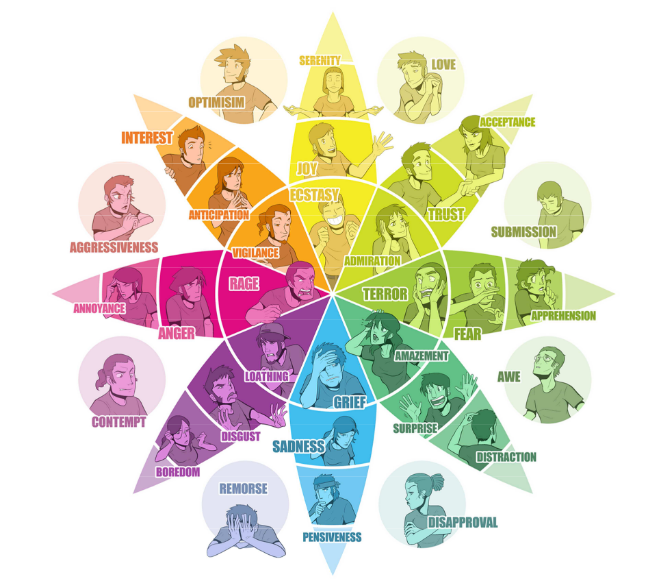
This state of mental tranquility, or “serenity,” was recently illuminated for me by a friend in the field of psychology. They introduced me to Professor Robert Plutchik’s “Wheel of Emotions,” a framework for understanding the spectrum of human feelings. While they viewed it as a pedagogical tool, I initially saw it as a source of potentially useful vocabulary for the IELTS exam. However, further research revealed its deeper significance. Of course, my friend’s insightful explanation saved me considerable time in grasping the concept.
 |
|---|
| Wheel of Emotion5 |
Emotions are not immutable; they can be influenced and even manipulated. The classic dilemma of choosing between heart and mind may be a lyrical construct, as the heart itself can be deceived. A prime example is the phenomenon explored in the documentary “The Tinder Swindler,” where anxiety-induced rapid heartbeat can be misinterpreted as romantic excitement. This begs the question: which is truly being deceived?
Exploring the mechanics of psychology and emotions, especially when combined with data analysis, can yield fascinating insights6. Perhaps this is due to my own tendency to gravitate towards projects involving simplistic emotion extraction models.
Transitioning from Retrospective to Present Awareness
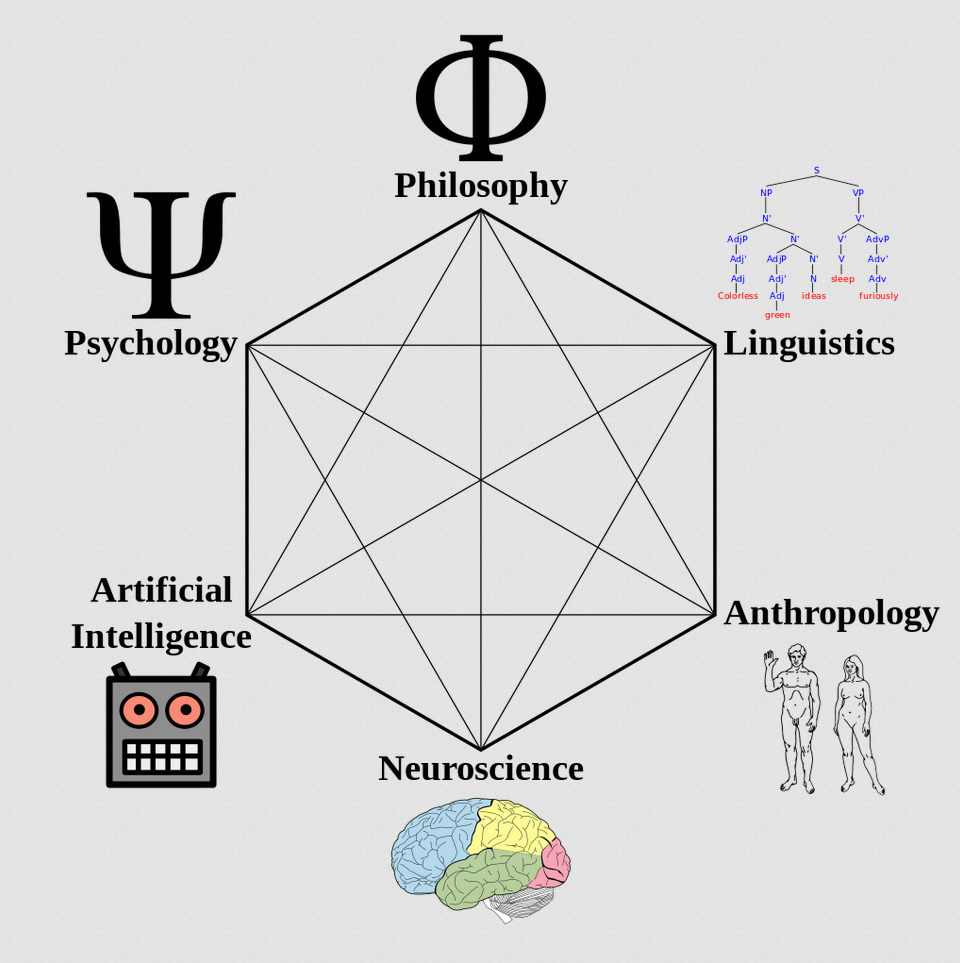
It seems that my reflections thus far have remained largely confined within the realm of internal contemplation, possibly influenced by my exposure to courses in Brain and Cognitive Sciences7, particularly neuroscience. In reality, these explorations—into neuroscience, psychology, philosophy, and even artificial intelligence—are all interconnected branches of cognitive science. My friends and I often engage in lighthearted discussions on these topics, acknowledging their vastness and the limited interdisciplinary connections within our current academic environment, likely due to the absence of readily established cognitive pathways.
 |
|---|
| Cognitive Science Hexagon |
In conclusion, the transition from a retrospective focus (“what has happened”) to a present-focused awareness (“what is happening”) is, in my view, an inevitable progression. It involves stepping outside the boundaries of previously established comfort zones that were once manageable. However, this process has led to a temporary lapse in my awareness of my current academic pursuits. Knowledge serves as a tool for skill development, and while habitual thinking may facilitate speed and ease, it doesn’t necessarily cultivate essential skills. Therefore, to venture beyond these confines, I must consciously break free from my current thought patterns.
 |
|---|
| Road and road sign |
Finally arriving in Qui Nhon, I anticipate a return to the mountains soon. I’ve come to realize that not only has my own perception evolved, but so has that of my family, as evidenced by a recent interaction when I went to meet a friend.
A Shift in Perspective
On the 6th day of the Lunar New Year, under a typically cool mountain climate, I approached my father:
“Dad, I’m planning to head down the mountain tomorrow to meet a friend. She’s visiting Gia Lai and will only be here for two more days.”
This statement was phrased as a notification, with the two-day timeframe added to enhance persuasiveness through the scarcity effect.
“Uh-huh, is it a boy or a girl?”
“Actually, it’s a girl, an older friend of mine.”
Honesty is the best policy.
“Alright, son, I understand. Be careful on the road. But your motorbike hasn’t been used much in a year since you’re rarely home. Make sure to check the tires, brakes, and everything before you go.”
Afterward, I went to meet my friend, and we had a pleasant time catching up before I returned home. To me, in the grand scheme of life, simply knowing someone is a valuable thing. However, family dynamics often involve different perspectives. For instance, my earlier conversation with my mother, after she learned of my plans:
“You’re going to meet a friend? Do you know her well? Where does she live? How old is she?”
“Mom, she’s just a friend, a close one. All I know is she’s from Gia Lai.”
“When you go to her place, remember to bring some fruit and greet her family properly.”
This is standard procedure for a formal family introduction.
If this had occurred five or six years ago, my mother’s reaction would likely have been even more intense. At this age, many of us probably navigate similar situations, striving to avoid misunderstandings. What I needed to demonstrate was the clarity of my relationships, emotional control, and honesty (as dishonesty can also trigger internal conflict). It’s a natural progression. Ultimately, the conversation made me realize my limited knowledge about the person I was meeting, and it underscored my appreciation for the genuinely kind people in my life.
Perhaps one day, the central question will shift from “What is happening?” to “What will happen?”.
 |
|---|
| Actually, I’m hiding a Cardcaptor’s staff, while the assassin duck is choosing a knife. |
-
Stephens-Davidowitz, S. (2018, February 10). Opinion, The Songs That Bind. The New York Times. https://www.nytimes.com/2018/02/10/opinion/sunday/favorite-songs.html ↩
-
Introduction to Computational Thinking. (2021). MIT 18.S191/6.S083/22.S092. https://computationalthinking.mit.edu/Spring21/climate2_snowball_earth/ ↩
-
Film Sri Siddhartha Gautama (tiếng Việt: “Buddha: Cuộc đời Đức Phật”), 2013, https://www.imdb.com/title/tt2629322 ↩
-
The emphasis here is on using knowledge to teach skills, where knowledge is secondary, and research/learning skills are primary. ↩
-
Wheel of Emotion – What Are You Really Feeling?, https://www.jacquelinehogan.com/wheel-of-emotion/ ↩
-
Scharl, A. (2022, February 6). Emotion Detection, Affective Computing. webLyzard Technology. https://www.weblyzard.com/emotion-detection/ ↩
-
Kanwisher, N. (2019). The Human Brain. MIT OpenCourseWare. https://ocw.mit.edu/courses/brain-and-cognitive-sciences/9-13-the-human-brain-spring-2019/ ↩